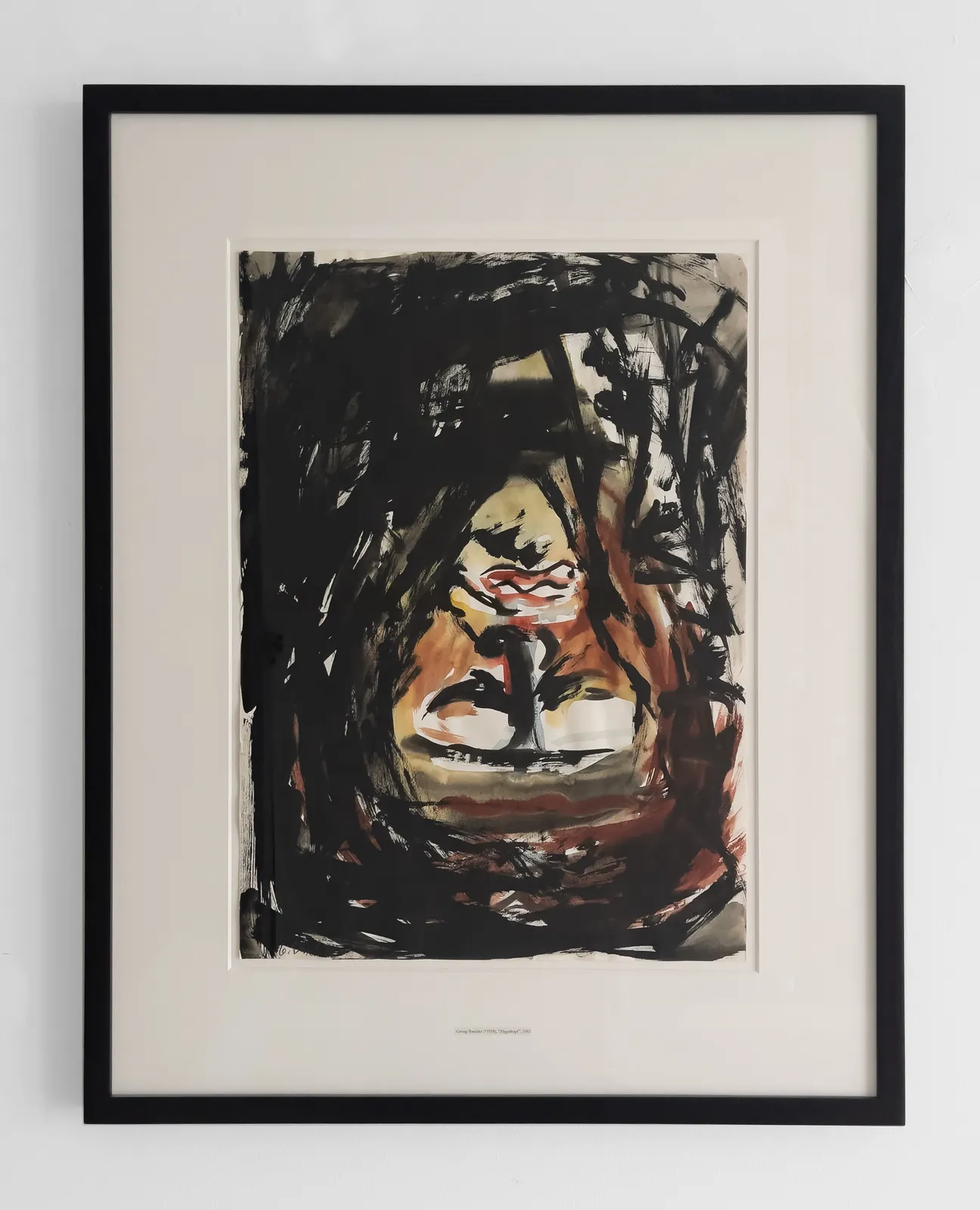
Georg Baselitz Germany, b. 1938
Abgarkopf, 1983
China ink, water colour, gouache on Fabriano handmade paper
65.7 x 47.7 cm
25 7/8 x 18 3/4 in
framed: 95.5 x 76.5 x 3 cm
25 7/8 x 18 3/4 in
framed: 95.5 x 76.5 x 3 cm
Copyright The Artist
Der Abgarkopf illustrates the legend of King Abgar, who, as a reward for his piety, received a missive from Christ, an image miraculously created when Jesus pressed a cloth to...
Der Abgarkopf illustrates the legend of King Abgar, who, as a reward for his piety, received a missive from Christ, an image miraculously created when Jesus pressed a cloth to his face. A popular medieval source described the resulting portrait as having good eyes, a strong brow, and a long face with straight features. In Baselitz’s work, these characteristics are retained, as is the close-cropping of the face, which recalls the original, uncomposed image. Yet Der Abgarkopf is forcefully, unrepentantly iconoclastic: Baselitz defies the latent power of the deified image by literally overturning it. This technique allows him to distance himself from the powerful symbolism associated with his chosen motif and, in doing so, to affirm his own status as a figurative painter in a turbulent post-War society. Der Abgarkopf becomes an icon, not of religion, but of humanism, allowing the artist to break loose from the subject and yet remain true to himself.
Georg Baselitz, born in 1938 in Kamenz-Deutschbaselitz, Germany, and currently based in Munich, is a pioneering contemporary painter known for his distinctive upside-down subjects and figures. As one of today's most renowned artists, Baselitz played a pivotal role in the emergence of New European Painting, responding to the enduring impact of World War II and reshaping German art in the post-war era. His influential career spans over six decades, beginning in the 1960s. Since 1969, Baselitz has challenged artistic norms by painting his pictures upside down. However, he has never confined himself to a single style or become predictable. He continually rejuvenates his practice through formal innovations and diverse art historical influences while maintaining his unique and unmistakable voice.
Baselitz masterfully straddles the line between figuration and abstraction. His upside-down approach seeks to strip forms of their conventional meaning, breathing new life into a medium that was thought to be fading. Alongside artists like Anselm Kiefer and Gerhard Richter, he revitalised figurative painting, infusing it with tactile intensity and a profound appreciation for the sensuous nature of paint itself, even experimenting with finger-painting techniques in the 1970s.
Georg Baselitz, born in 1938 in Kamenz-Deutschbaselitz, Germany, and currently based in Munich, is a pioneering contemporary painter known for his distinctive upside-down subjects and figures. As one of today's most renowned artists, Baselitz played a pivotal role in the emergence of New European Painting, responding to the enduring impact of World War II and reshaping German art in the post-war era. His influential career spans over six decades, beginning in the 1960s. Since 1969, Baselitz has challenged artistic norms by painting his pictures upside down. However, he has never confined himself to a single style or become predictable. He continually rejuvenates his practice through formal innovations and diverse art historical influences while maintaining his unique and unmistakable voice.
Baselitz masterfully straddles the line between figuration and abstraction. His upside-down approach seeks to strip forms of their conventional meaning, breathing new life into a medium that was thought to be fading. Alongside artists like Anselm Kiefer and Gerhard Richter, he revitalised figurative painting, infusing it with tactile intensity and a profound appreciation for the sensuous nature of paint itself, even experimenting with finger-painting techniques in the 1970s.
Provenance
Galerie Daniel Blau, Munich, GermanyPrivate Collection, UK
Exhibitions
Rex Irwin, 38 Queen Street, Sydney, Australia, 30 August – 24 September, 2011Galerie Daniel Blau, Munich, Nulla dies sine linea. 1960's German Drawings from the Gachnang
Collection, 6 July- 29 July 2006
Van Abbemusseum, Eindhoven, Georg Baselitz - Zeichnungen 1958-1983, 28 January- 26 February 1984
Literature
Nulla dies sine linea. 1960's German Drawings from the Gachnang Collection, p.4, Exhibition
catalogue, Galerie Daniel Blau, Munich 2006
Join our mailing list
* denotes required fields
In order to respond to your enquiry, we will process the personal data you have supplied to communicate with you in accordance with our Privacy Policy. You can unsubscribe or change your preferences at any time by clicking the link in our emails. This site is protected by reCAPTCHA and the Google: Privacy Policy and Terms of Service apply.