
Max Ernst Germany, 1891-1976
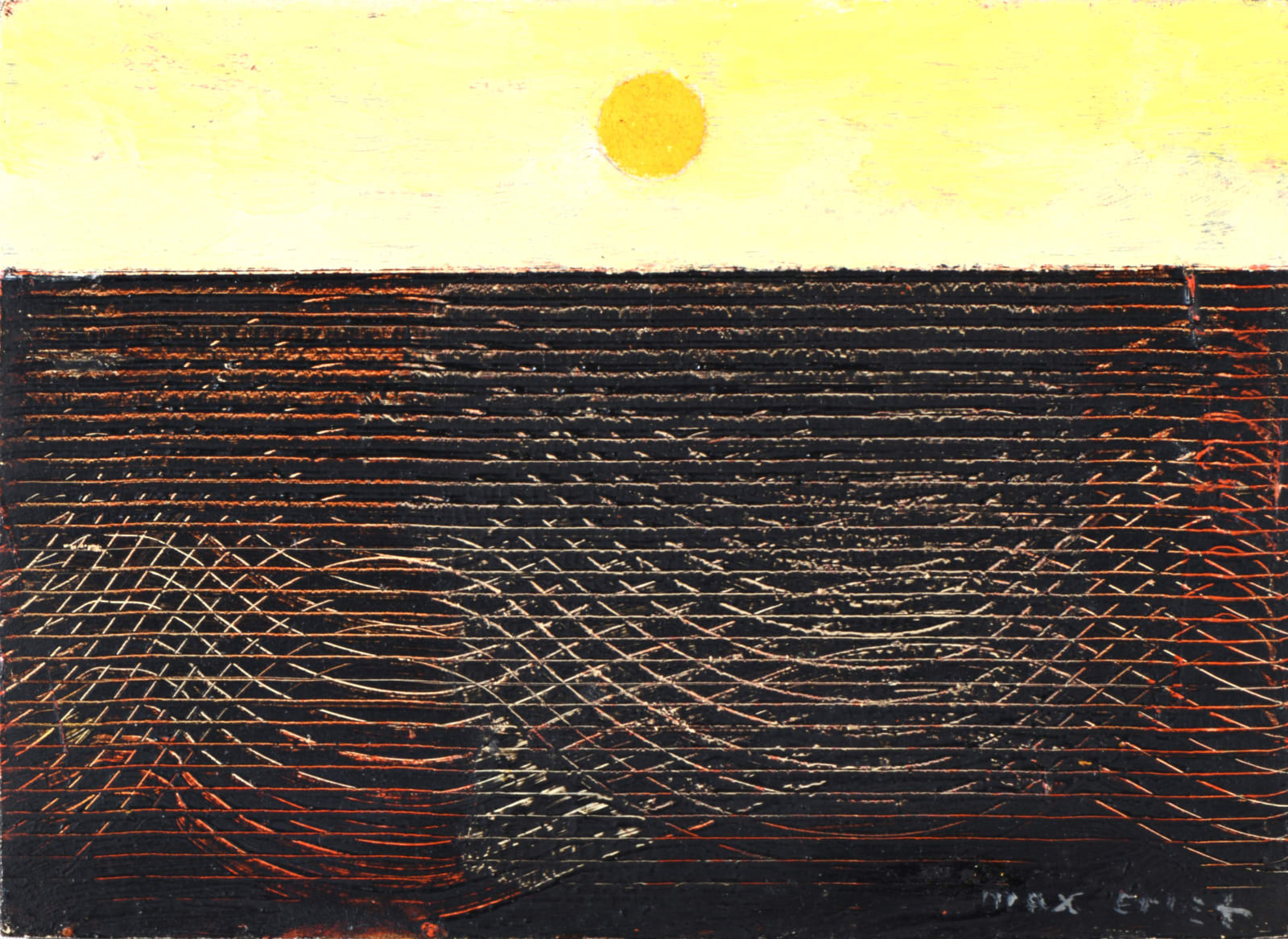
Mer, c .1956
oil on wood
11.5 x 15 cm | 4 1/2 x 5 7/8 in
framed: 22.2 x 27.3 x 2.2 cm
Signed lower right "Max Ernst"
framed: 22.2 x 27.3 x 2.2 cm
Signed lower right "Max Ernst"


Painted in 1956, Mer is a late and evocative work by Max Ernst that reflects his lifelong fascination with nature, abstraction, and the unconscious. The canvas is divided horizontally: a...
Painted in 1956, Mer is a late and evocative work by Max Ernst that reflects his lifelong fascination with nature, abstraction, and the unconscious. The canvas is divided horizontally: a luminous yellow sky above, marked by a single sun or moon, contrasts with a dark, textured lower section. Using his grattage technique, Ernst scraped through layers of paint to create an intricate field of undulating lines, evoking a sea, a cracked earth, or an otherworldly surface.
This blending of spontaneity and control lies at the heart of the work. While the grattage marks appear automatic, Ernst refined them with careful brushwork, allowing chance textures to transform into symbolic forms. The painting resists easy interpretation. Its title suggests a seascape, yet the lower portion might also read as desert or cosmic terrain, underscoring Ernst’s interest in ambiguity and dreamlike imagery.
Mer was painted during a period of international recognition, just two years after Ernst won the Grand Prize at the Venice Biennale. That same year, he returned to Sedona, Arizona, whose desert landscape influenced the work’s meditative tone. The painting was acquired by Edouard Loeb, brother of Surrealist gallerist Pierre Loeb, signaling a personal and lasting connection to Ernst’s visionary world.
This blending of spontaneity and control lies at the heart of the work. While the grattage marks appear automatic, Ernst refined them with careful brushwork, allowing chance textures to transform into symbolic forms. The painting resists easy interpretation. Its title suggests a seascape, yet the lower portion might also read as desert or cosmic terrain, underscoring Ernst’s interest in ambiguity and dreamlike imagery.
Mer was painted during a period of international recognition, just two years after Ernst won the Grand Prize at the Venice Biennale. That same year, he returned to Sedona, Arizona, whose desert landscape influenced the work’s meditative tone. The painting was acquired by Edouard Loeb, brother of Surrealist gallerist Pierre Loeb, signaling a personal and lasting connection to Ernst’s visionary world.
Provenance
Edouard Loeb, Paris.Herman C. Goldsmith, New York.
Literature
Max Ernst, catalogue raisonné, Werner Spies, Sigrid et Günter Metken, Max Ernst Werke,1925-1929, DuMont Verlag, Köln, 1976, 1954-1963, p. 82, 3204.


